

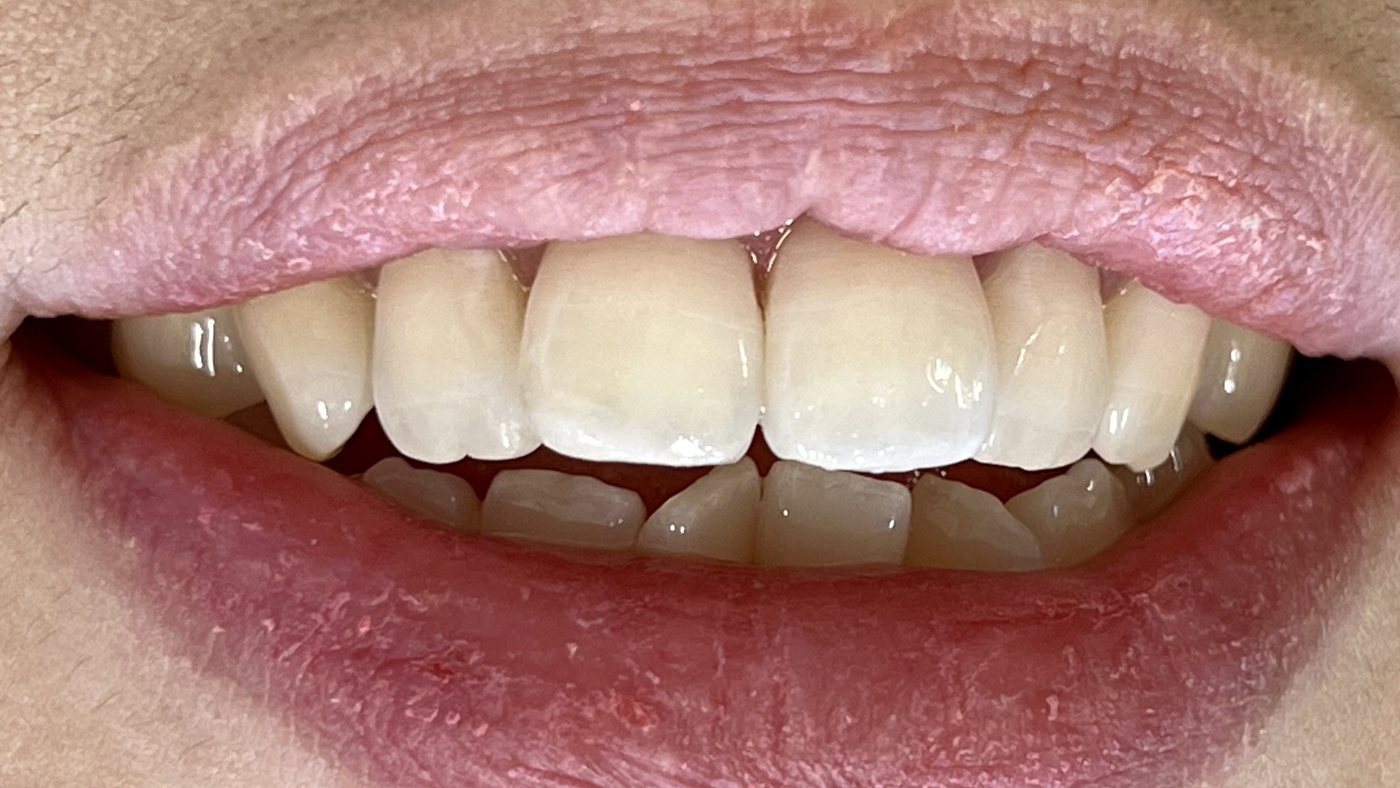
A cracked tooth often announces itself with a sharp pain when you bite, then nothing. It is easy to ignore, and easy to fear the worst.
In most cases, a cracked tooth can be kept. The key is finding out what kind of crack it is, and treating it before it spreads.
What are the signs of a cracked tooth?
Cracked teeth cause symptoms that come and go, which is why they are often missed. The most common signs are:
- Sharp pain when biting, especially as you release the bite.
- Pain with cold food or drinks.
- Pain that comes and goes rather than a constant ache.
- A visible line on the tooth, or a piece that has broken off.
Some cracks cause no symptoms at all and are found at a check-up. Cracks are also hard to see on ordinary X-rays, so a careful exam matters.
What are the five types of tooth cracks?
The American Association of Endodontists describes five types. The type decides whether, and how, a tooth can be saved.
| Type | What it is | Can the tooth be saved? |
|---|---|---|
| Craze lines | Tiny lines in the outer enamel only | Yes. Usually no treatment needed, other than for appearance |
| Fractured cusp | A corner of the chewing surface breaks, often around a filling | Usually, with an onlay or crown |
| Cracked tooth | A crack running from the chewing surface down toward the root | Often, if found early. A root canal is added if the nerve is affected |
| Split tooth | A crack that has separated the tooth into two parts | Rarely. Sometimes part of the tooth can be kept |
| Vertical root fracture | A crack that starts in the root, usually in a tooth with a past root canal | Usually not, and the tooth is replaced |
Classification: American Association of Endodontists, as summarized by Spear Education.
Can a cracked tooth be saved?
Yes, in most cases. The evidence for cracked teeth found and treated in time is encouraging.
- In everyday practice. In the national Cracked Tooth Registry, 209 dentists followed 2,858 patients with a cracked back tooth. After three years, over 98% of the teeth were still in place.
- When the nerve is healthy. A 2024 meta-analysis found that 93–98% of cracked teeth with a healthy nerve survived over one to six years.
- After a root canal. When the crack had reached the nerve and needed a root canal, 83–91% of teeth survived over one to four years.
The same meta-analysis found that root-canal-treated cracked teeth without a crown were about 11 times more likely to be lost than those with one. Covering the tooth matters.
How is a cracked tooth treated?
Treatment depends on the type of crack and the health of the nerve. A conservative approach starts with the least invasive option that will hold the tooth together.
- Monitoring. Craze lines and some small cracks without symptoms are watched at check-ups rather than treated.
- A bonded filling or onlay. For a broken cusp or a small crack, a restoration that covers the weak area can be enough. For teeth with a healthy nerve, a 2024 meta-analysis found that bonded fillings did about as well as full crowns over one to three years.
- A crown. A full or partial crown holds the cracked tooth together, like a band around a barrel. In the registry, treatment failures were linked with fillings placed inside the tooth rather than with crowns or partial crowns.
- Root canal treatment and a crown. If the crack has reached the nerve, the inside of the tooth is cleaned and sealed, then crowned.
- Crown lengthening. If the crack runs just below the gumline, reshaping the gum and bone can expose enough healthy tooth for a crown.
- Replacement. A split tooth or a vertical root fracture usually can’t be kept. Then the tooth is removed and replaced, often with an implant.
For more on saving teeth that seem beyond repair, read our guide to modern root canal care.
Should you treat a cracked tooth right away?
Have it examined soon. A crack doesn’t heal, and one that keeps spreading can turn a treatable tooth into a split one.
Pain often settles over time. In the registry’s three-year follow-up, biting or spontaneous pain resolved for most patients, but treatment resolved more of it than leaving the tooth alone.
Not every crack needs treatment immediately. The exam tells you whether yours should be treated now or watched.
What does treating a cracked tooth cost in NYC?
At US average fees, a porcelain crown costs about $1,399, and a root canal, if the nerve is affected, $984–$1,337. Replacing a lost tooth with a standard implant averages about $4,344. Manhattan fees generally run above national averages.
| Treatment | Fee |
|---|---|
| Porcelain crown, US average | $1,399 |
| Root canal, US average | $984–$1,337 |
| Standard implant, US average per tooth | $4,344 |
| Shin Dental: consultation, exam and X-rays included | Free |
| Shin Dental: second opinion on a tooth recommended for extraction | $150 |
| Shin Dental: implant, including placement and crown | $3,500–$4,500 |
US averages: CareCredit, based on ASQ360° cost studies, 2023–2024.
Treating a crack early is usually the least expensive path. Waiting until a tooth splits often means paying to replace it.
How can you prevent a cracked tooth?
Most cracks come from forces a tooth can’t withstand over time. These habits lower the risk:
- Wear a night guard if you grind or clench your teeth.
- Avoid chewing ice, hard candy, pens or popcorn kernels.
- Have large or worn fillings checked, since they can leave the tooth around them weaker.
- Keep regular check-ups, so small cracks are found before they spread.
What happens at a cracked-tooth exam?
A cracked-tooth exam at Shin Dental follows four steps.
- Your history. When it hurts, what triggers it, and how long it has been happening.
- A close examination. Dr. Shin examines the tooth and tests how it responds to biting and cold.
- Imaging. X-rays, and a 3D CBCT scan in our office when needed, to see how far the crack and any damage extend.
- A written plan. Your options, least invasive first, with the cost of each.
If another dentist has told you the tooth must come out, a second-opinion visit is $150, credited toward treatment if you begin with us.
Why do patients trust Dr. Shin and his team?
Dr. Shin practices conservative, minimally invasive dentistry: he looks for the way to keep your natural tooth, and he tells you plainly when a tooth can’t be saved.
Dr. Peter Shin grew up watching his father practice dentistry. He runs his own practice the same way: unhurried appointments, clear explanations, and treatment planned around what will last.
- Training: DDS from the New York University College of Dentistry, an Advanced Education in General Dentistry (AEGD) residency at NYU, and live-surgery implant training.
- Clear costs: every recommended treatment comes with an itemized cost breakdown, reviewed with you in person before anything starts.
- No surprise bills: once treatment is complete, you will not owe anything beyond what was disclosed beforehand.
- Insurance: we are an out-of-network provider for PPO plans, file your claims for you, and can request a pre-determination of benefits before you commit.
“The best dentist I've ever seen. The staff was so friendly and helpful and Dr. Hyo Sup Shin was extremely nice and explained everything regarding my teeth. Found my new dentist and would highly recommend to anyone.”
Where is Shin Dental?
- Address: 30 Central Park South, Suite 11D, New York, NY 10019, between Fifth and Sixth Avenues in Midtown Manhattan.
- Subway: 5 Av/59 St (N, R, W) is a one- to two-minute walk. The F stops at 57 St and Sixth Avenue, about four minutes away.
- Bus: the M5 stops at Central Park South and Sixth Avenue.
- Hours: Monday to Friday, 9:00 AM – 7:00 PM. Saturday, 9:00 AM – 1:00 PM. Closed Sunday.
- Phone and text: (917) 773-1353.
Questions patients ask
Will a cracked tooth heal on its own?
No. The crack itself doesn’t heal. The pain sometimes settles, but the crack can keep spreading, so it is worth having the tooth examined even if it stops hurting.
Does every cracked tooth need a root canal?
No. Most cracked teeth are treated with a filling, onlay or crown. A root canal is added only if the crack has reached the nerve and it is inflamed or infected.
How long does a crowned cracked tooth last?
In a national study, over 98% of cracked back teeth were still in place after three years, most of them treated with crowns. How long yours lasts depends on how deep the crack runs and on your bite and habits.
Is a cracked tooth an emergency?
Call us the same day if you have severe pain, swelling, or a piece of tooth has broken off. Otherwise, book an exam soon, before the crack has a chance to spread.
I was told my cracked tooth must be pulled. Can you check?
Yes. Our second-opinion visit is $150, in person or by video, and is credited toward treatment if you begin with us. If the tooth can’t be saved, we will tell you why and explain how it can be replaced.
Book a free consultation
The consultation is free, with your exam and X-rays included. If you have been told the tooth must come out, a second opinion is $150, credited toward treatment.
This article is general information, not a diagnosis. Fees and how long treatment lasts depend on each patient’s dental condition, which Dr. Shin assesses at your consultation. US and New York figures are published averages and estimates, shown for comparison only. Individual results vary.
Sources
- National Dental Practice-Based Research Network Collaborative Group (Funkhouser E et al.). “Onset and resolution of pain among treated and untreated posterior teeth with a visible crack: Three-year findings.” Journal of Dentistry 119 (2022): 104078. Link
- National Dental Practice-Based Research Network, Cracked Tooth Registry Study, three-year outcomes (2022). Link
- Zhang S, Xu Y, Ma Y, Zhao W, Jin X, Fu B. “The treatment outcomes of cracked teeth: A systematic review and meta-analysis.” Journal of Dentistry 142 (2024): 104843, summarized by the Dental Elf. Link
- Spear Education, “How to Recognize the 5 Types of Tooth Cracks,” citing the American Association of Endodontists classification. Link
- CareCredit, “Dentist Prices: Dental Procedure Cost List,” based on the ASQ360° Average Procedural Cost Studies for Synchrony (2023–2024). Link